Get monthly marketing insights straight to your inbox.
Thank you! Your submission has been received!
Oops! Something went wrong while submitting the form.



Posted by:
Highland Group
Posted on:
11/12/2026
You could rebuild your website, invest in your brand, create more content or increase paid media. You could improve your search presence, add new marketing technology or build a stronger lead generation engine.
For a CEO looking at 2027 growth goals, the challenge usually isn't finding opportunities. There are always plenty of those. It's deciding which ones actually deserve the investment.
That decision gets especially complicated when the business already has momentum. Sales may be strong, the company may have grown significantly and relationships and referrals may have played an important role in getting it there. But as the organization enters a new chapter — whether that means pursuing a new market, setting a more ambitious growth target, reaching a changing customer base or simply becoming a bigger version of the business it used to be — marketing may need to start doing more of the work.
There isn't a universal marketing mix for that moment, nor is there a percentage of revenue that can tell you exactly how much should go toward brand, digital, content or demand generation. It would certainly make annual planning easier if there were.
The better place to start is with the constraint: What is currently preventing marketing from contributing more to the growth of the business?
Once you know that, deciding where to invest gets much easier.
Marketing budget conversations have a tendency to begin with channels: digital, paid media, website and so on.
Those may eventually be the right questions, but starting there puts the investment decision ahead of the strategy — a little like choosing the tools before you know what you're building.
Consider two companies with the same growth goal and the same marketing budget. On paper, their plans might look similar. But the problem each company needs marketing to solve points to two very different investment strategies.
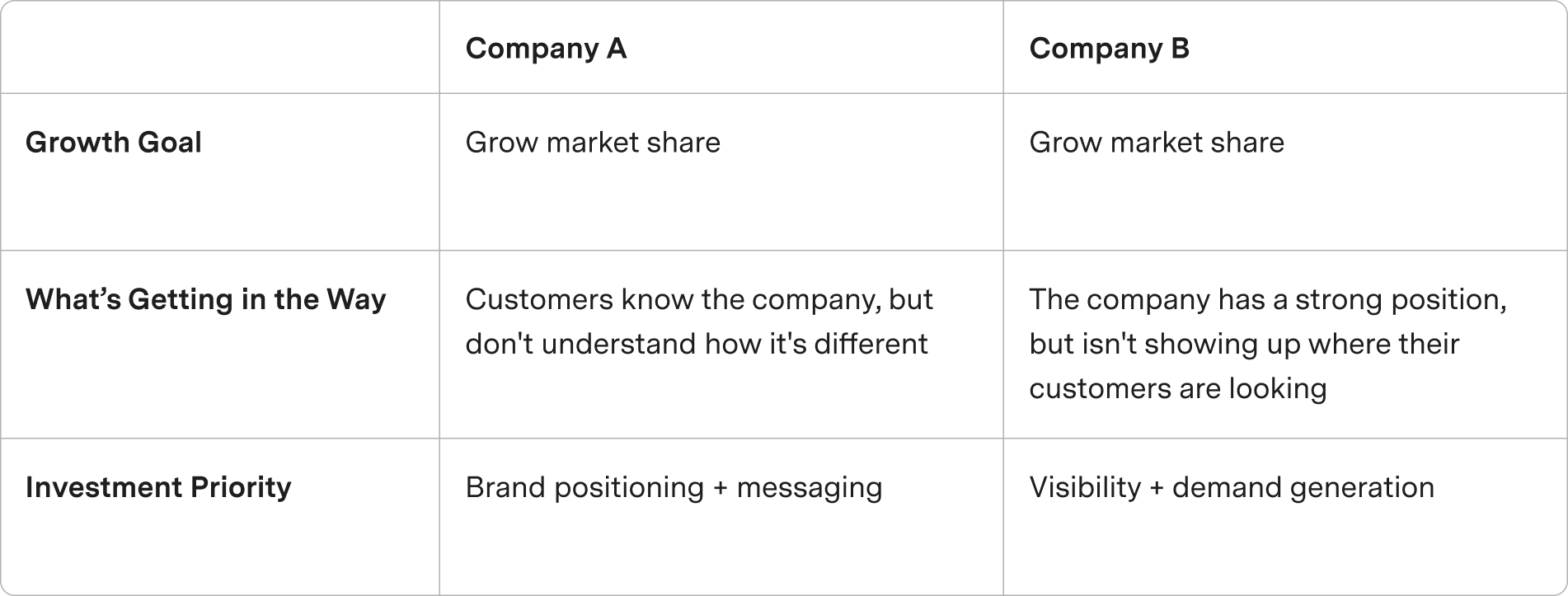
Same goal and budget, but very different places to put it.
The same distinction applies to companies with strong sales but relatively immature marketing. Growth may have been driven for years by relationships, reputation and a talented sales team. Eventually, however, the business can reach a point where those strengths need a larger system around them.
Marketing has to help create awareness before the sales conversation, support customers throughout a longer decision process and make the organization easier to understand and choose.
Before allocating another dollar, identify what's actually limiting the next stage of growth:
Your budget should follow the answer, not the other way around.
Before you put more money behind your marketing, make sure the juice is worth the squeeze.
In other words, make sure the foundation you’re investing in is strong enough to support more attention. Because sometimes the fastest way to waste a marketing budget is to make an unresolved problem more visible.
A weak foundation can show up in a few different ways…
In each case, spending more doesn't solve the underlying problem. It just gives the problem a bigger audience.
Lesson learned: More marketing isn't particularly helpful when it's amplifying the wrong thing.
This is particularly important for businesses entering a “2.0” stage of growth. As the company expands its services, reaches new customers and navigates more sophisticated sales conversations, the marketing supporting it doesn't always evolve at the same pace. Before long, the website, messaging and broader marketing engine can start to look and sound like an earlier version of the business.
The business moved forward, yet the marketing didn't quite come with it.
A useful test: If twice as many prospective customers encountered your marketing tomorrow, would you be happy with what they found?
If the answer is no, attracting twice as many people probably shouldn't be the first priority.
The most valuable marketing investment isn't always the one with the easiest return to isolate on a dashboard, but the one that makes everything around it work harder.
The value of these investments often extends well beyond their immediate purpose:
This creates an important distinction when you're deciding between competing priorities: Are you investing in something that performs one job, or something that can make several parts of your marketing work harder?
Of course, not every investment needs to deliver value across the entire marketing ecosystem. Businesses still need campaigns that create demand now and programs designed to hit near-term goals. 2027 still has revenue targets, after all.
But when budgets are limited, it’s worth looking for investments with a longer reach. A stronger brand, website, content strategy or customer data foundation can solve an immediate need while continuing to improve the performance of the marketing around it.
The real leverage comes from what happens next. Beyond solving today’s need, the right investment can make future investments more effective, too.
There will always be something new competing for your attention… and usually something suggesting you're already behind for not investing in it.
AI is hardly new to that conversation. It’s dominated business and marketing discussions for the past several years, and that attention will only intensify heading into 2027. The question for CEOs is shifting from whether AI will affect their business to where it can actually create meaningful value.
Our CEO, Scott Crowley, has seen that uncertainty firsthand in conversations with other business leaders through his CEO Roundtable groups. There’s no shortage of interest in AI, but many leaders are still working through a much more practical question: How do we use it to our advantage?
That’s an important distinction when you’re building a marketing budget. Search is changing, platforms are evolving and AI continues to open up new possibilities for everything from customer experiences to internal efficiency. Those shifts are worth understanding, but new capability alone isn’t a strategy.
The more useful question is what AI (or any emerging technology) makes possible for your business.
Maybe it can help customers find answers more easily during a complex buying process. Perhaps there’s an opportunity to reduce repetitive work and give your team more time for higher-value thinking. Or changes in how your audience searches may require you to rethink how and where your brand shows up.
The goal isn’t to find a place for AI in the budget simply because everyone is talking about it. It’s to identify where AI can solve a real business problem, create an advantage or make an existing investment work harder.
That’s a much better starting point than “We need to do something with AI.”
A trend can create an opportunity, but it doesn't automatically deserve a line item. New capabilities earn their place in the budget when there’s a clear reason for the business to use them.
Ultimately, allocating a marketing budget isn't about finding the perfect mix of brand, website, content and demand generation. There’s no magic formula, as convenient as that would be.
It's about deciding what the business needs marketing to make possible next and putting your resources behind the investments most likely to get you there.
A few examples make that distinction clearer:
And sometimes the answer isn't one isolated project. Businesses rarely grow in neat, single-problem increments.
A company that has outgrown its marketing may need a connected system: a sharper brand supported by a digital experience that reflects it, useful content that builds authority and campaigns that put that story in front of the right audiences. Those investments shouldn't be fighting one another for budget or attention.
The real value comes when each one makes the others work harder.
That's also why the question isn't simply, “What should we spend more on?” It’s “What needs to be true for this business to reach its next stage of growth — and what role should marketing play in getting us there?”
That’s a much more useful question to bring into a budget meeting. Answer it first, and the numbers become much easier to build around.
The strongest marketing budgets aren't necessarily the biggest. They're the ones built around clear choices, including what doesn't make the cut.
As your business grows, those choices also need to work together. Your brand, website, content and campaigns shouldn't be pulling in different directions, and leadership shouldn't have to play air traffic control between multiple partners just to keep everything aligned.
Highland Group helps growth-oriented organizations turn business priorities into one connected marketing strategy. We bring brand, digital, content and campaigns together under one agency partnership, so your marketing can keep pace with where the business is headed.
If you're asking marketing to do more in 2027, let's make sure every investment has a reason to be there. Ready to figure out where to focus? Reach out to us.